
Why is the oil yield of solvent extraction process higher than that of pressing process?
In the production of edible oil, solvent extraction process and pressing process are two common methods to make oil. In contrast, the oil yield of solvent extraction process is usually significantly higher than that of pressing process, which is mainly related to the principle and operation mode of the two processes.
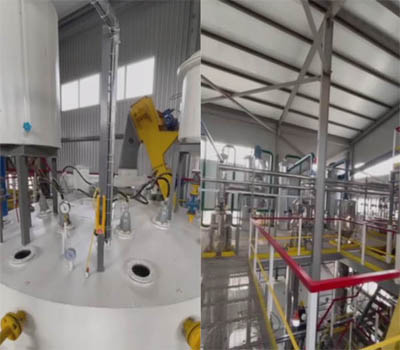
First of all, from the perspective of process principle, the pressing process is to squeeze oil out of raw materials through mechanical pressure. This method depends on the physical squeezing ability of mechanical equipment. Although it is simple and efficient, it is difficult to completely release some oil in raw materials because it is wrapped by cell wall. Therefore, the oil yield of pressing process is often limited, especially for raw materials with low oil content or compact structure.
In contrast, the solvent extraction process uses chemical extraction. Specifically, it uses organic solvents (such as n-hexane) to dissolve the oil in raw materials and extract the oil from raw materials. Through pretreatment such as crushing, flaking, cooking, etc., the solvent can penetrate into the tiny pores of the raw materials and fully contact with the oil in the cell wall, so as to extract the oil more thoroughly. This chemical diffusion and dissolution enable the leaching process to recover the oil in the raw materials to the maximum extent, so its oil yield is usually higher than that of the pressing process.
Secondly, from the operation process, the pressing process usually needs to be carried out at higher pressure and temperature, and it is easily affected by factors such as water content of raw materials and particle size. If the operation is improper, some grease may remain in the pressed cake. The solvent extraction process is relatively more flexible. By adjusting the solvent ratio, temperature and soaking time, it can better adapt to the characteristics of different raw materials, thus improving the extraction efficiency.
Besides, the solvent extraction process also has the advantage of large treatment scale. In industrial production, solvent extraction can treat a large number of raw materials in a continuous way, which not only improves the production efficiency, but also further reduces the cost. However, it should be noted that although the solvent extraction process is excellent in oil yield, its production process involves the use of organic solvents, which requires high equipment sealing and environmental protection. The squeezing process is more natural and environmentally friendly, so it still plays an important role in some small processing plants or organic food production.
To sum up, the reason why solvent extraction technology has higher oil yield than pressing technology is mainly due to its chemical extraction principle and more flexible operation mode. However, the two processes have their own advantages and disadvantages, and the appropriate oil production method should be selected according to the specific needs in practical application.