
Loss types in edible oil refining process
The whole process of degumming, deacidification, decoloration and deodorization of edible oil refining will produce oil loss, which is determined by the quality of crude oil, process parameters, equipment performance and operation management. The core causes of loss in each section are as follows:
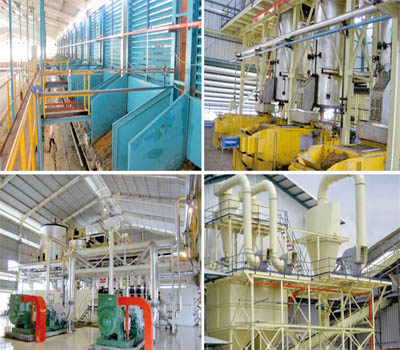
Degumming loss
Degumming removes lipids, phospholipids, gums and impurities, and the main loss is the emulsification and entrainment loss of neutral oil. Unreasonable acid dosage, temperature and stirring parameters are easy to cause emulsification, and neutral oil is discharged with rubber residue and oil residue, resulting in oil loss.
Deacidification loss in alkali refining
Alkali refining is the process with the highest refining loss. The sources of loss include: chemical loss caused by saponification of neutral oil; Improper process control leads to oil-water emulsification, and oil is mixed with soap feet; The efficiency of separation equipment is low, and the residual neutral oil in soap feet cannot be recovered.
Decolorization loss
Using clay to adsorb and decolorize, the loss is mainly residual oil carried by waste clay. Calculation formula: decolorization loss = waste clay mass × oil content on dry basis. Large amount of white clay, high temperature and incomplete cake blowing will greatly increase the loss of residual oil.
Deodorization loss
In the process of high-temperature and high-vacuum stripping deodorization, the loss comes from the removal of volatile impurities, the accompanying volatilization of trace nutrients, the high-temperature splash of neutral oil, and the oil loss caused by vacuum leakage and steam entrainment, which is greatly influenced by temperature, vacuum degree and steam consumption.
Other losses
Although the hidden losses such as water washing emulsification, residual oil filtration, oil storage in pipelines and equipment leakage are few at a time, long-term accumulation will significantly increase the overall refining loss.
Refining loss belongs to systematic loss. Stabilizing crude oil quality, strictly controlling key parameters such as acid and alkali dosage, temperature, vacuum degree and clay consumption, recording refining consumption data and optimizing process are the keys to reduce oil loss and save production cost.